

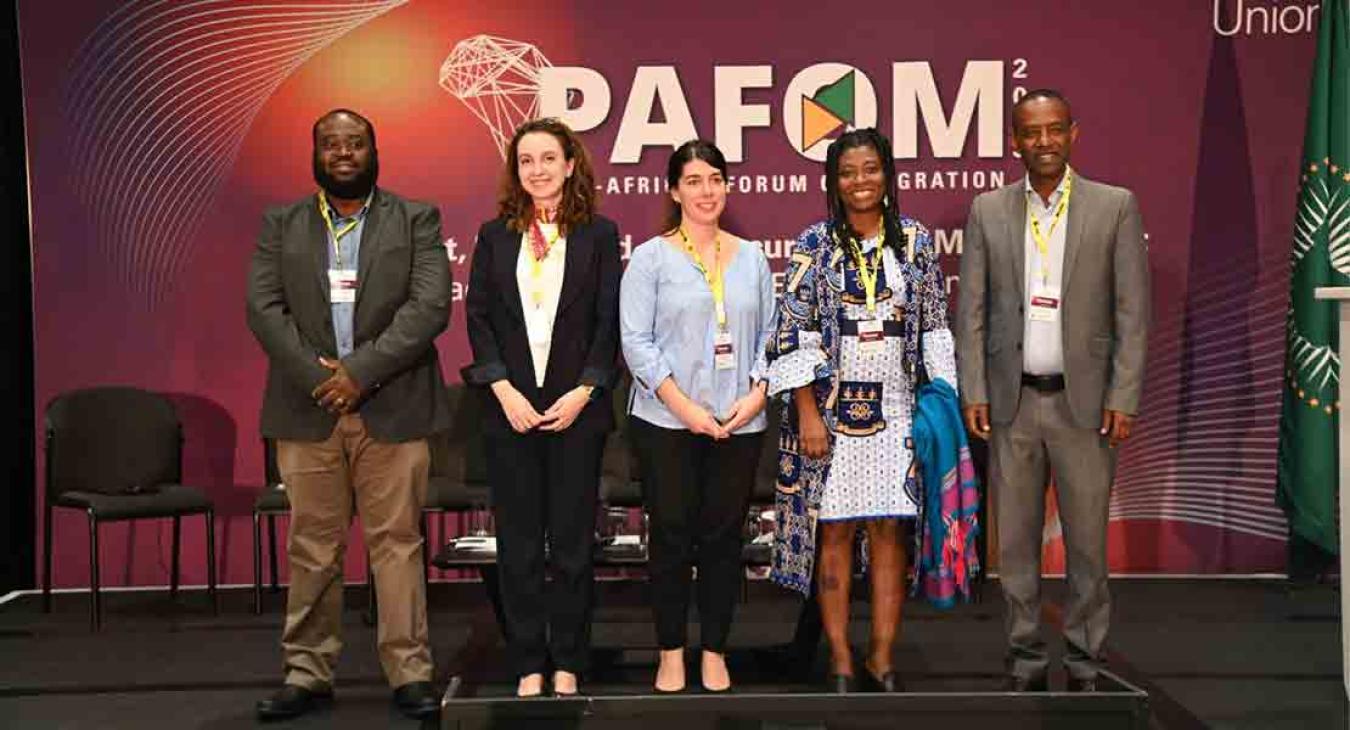
The IDRC Research Chair on Forced Displacement in Anglophone West Africa and Director of the Centre for Migration Studies (CMS), University of Ghana, Prof. Mary B. Setrana, has highlighted the importance of sustained Africa–Europe research collaboration and robust migration data systems in strengthening migration governance across the continent.
She made the presentation at the 9th Pan-African Forum on Migration (PAFoM IX) in Cape Town, South Africa, where senior African Union officials, Heads of Immigration, policymakers, academics and migration experts have gathered to deliberate on technology-driven approaches to human mobility and trade in Africa. The three-day Forum coincided with the observance of International Migrants Day 2025.
PAFoM IX, organised by the African Union Commission (AUC) under the theme “Leveraging Technology for Efficient Human Mobility and Trade in Africa,” focuses on modernising border management systems to advance regional and continental integration, trade facilitation and safe mobility in line with Agenda 2063, the African Continental Free Trade Area (AfCFTA) and the Protocol on Free Movement of Persons.
In her presentation titled “Past, Present and Future Collaboration with the African Union Commission on Migration Research and Data,” Prof. Setrana positioned the Centre for Migration Studies as a leading regional migration research and policy institution, established in 2006 with a mandate covering research, training, policy advisory services and migration data.
“The Centre for Migration Studies has anchored Ghana’s migration scholarship while contributing directly to national, regional and continental migration frameworks,” she stated.
She noted that CMS maintains longstanding partnerships with the AUC, the International Organization for Migration (IOM), GIZ, ILO, the European Union and other UN agencies, providing technical support to AU migration frameworks, regional economic communities and Member States.
Prof. Setrana highlighted CMS’ contribution to the Mid-Term Assessment of the AU Migration Policy Framework for Africa, covering 55 Member States and eight Regional Economic Communities, as well as its advisory role on free movement, labour migration, displacement, return and reintegration initiatives.
At the national level, she explained that CMS research has informed major policy frameworks, including Ghana’s National Migration Policy (2016) and Diaspora Engagement Policy (2019), alongside migration and labour migration policies in Sierra Leone.
She further outlined ongoing and recent research projects feeding into debates on free movement, trade and labour mobility, including MIGNEX, Crises as Opportunities, MIAG – Migration for Inclusive African Growth, Urban Sanctuary, Governing Climate Mobility in Ghana, MITRA/WA and FUTUREMEG.
“Our research consistently translates evidence into policy briefs, tools and training modules that support labour and skills mobility, regional integration and informal cross-border trade,” Prof. Setrana added.
She also referenced CMS flagship projects such as the MAFE Project, Migrating Out of Poverty, MADE West Africa and the National Migration Survey Project, which have significantly strengthened migration data systems and policy coherence across Africa and Africa–Europe migration corridors.
Looking ahead, Prof. Setrana identified opportunities for deepening collaboration between CMS and the AUC, including joint research on Free Movement Protocol implementation, labour and skills mobility under AfCFTA, data harmonisation, support to AU migration observatories, and the establishment of an institutionalised AU–CMS research partnership.
PAFoM IX builds on recommendations from PAFoM VIII, held in Gaborone, Botswana, in 2023, which called for accelerated digitalisation and automation of border management systems to reduce bottlenecks to trade and mobility. Speaking at the Forum, Dr. Sabelo Mbokazi, Head of Labour, Employment and Migration at the AUC, noted that the discussions seek to enhance security while enabling faster, safer cross-border movement across Africa.
The participation of the Centre for Migration Studies, University of Ghana, at PAFoM IX reinforces the University’s contribution to evidence-based migration governance, continental integration and Africa–Europe policy dialogue.
- Log in to post comments